Challenges faced
Making team decisions usually feels like a choice between two evils: endless meetings that go nowhere or scattered Slack polls that don't tell the whole story. While a quick thumbs-up emoji gives you a result, it completely misses the why. You end up with a "winner" but no real understanding of people's concerns or the nuance behind their preferences.
I realized there was a massive gap for a tool that’s actually lightweight but still manages to gather structured, asynchronous feedback. Teams shouldn't have to jump on a call just to understand the collective vibe, they need a better way to see the full picture without the bias or the lag.
Solution
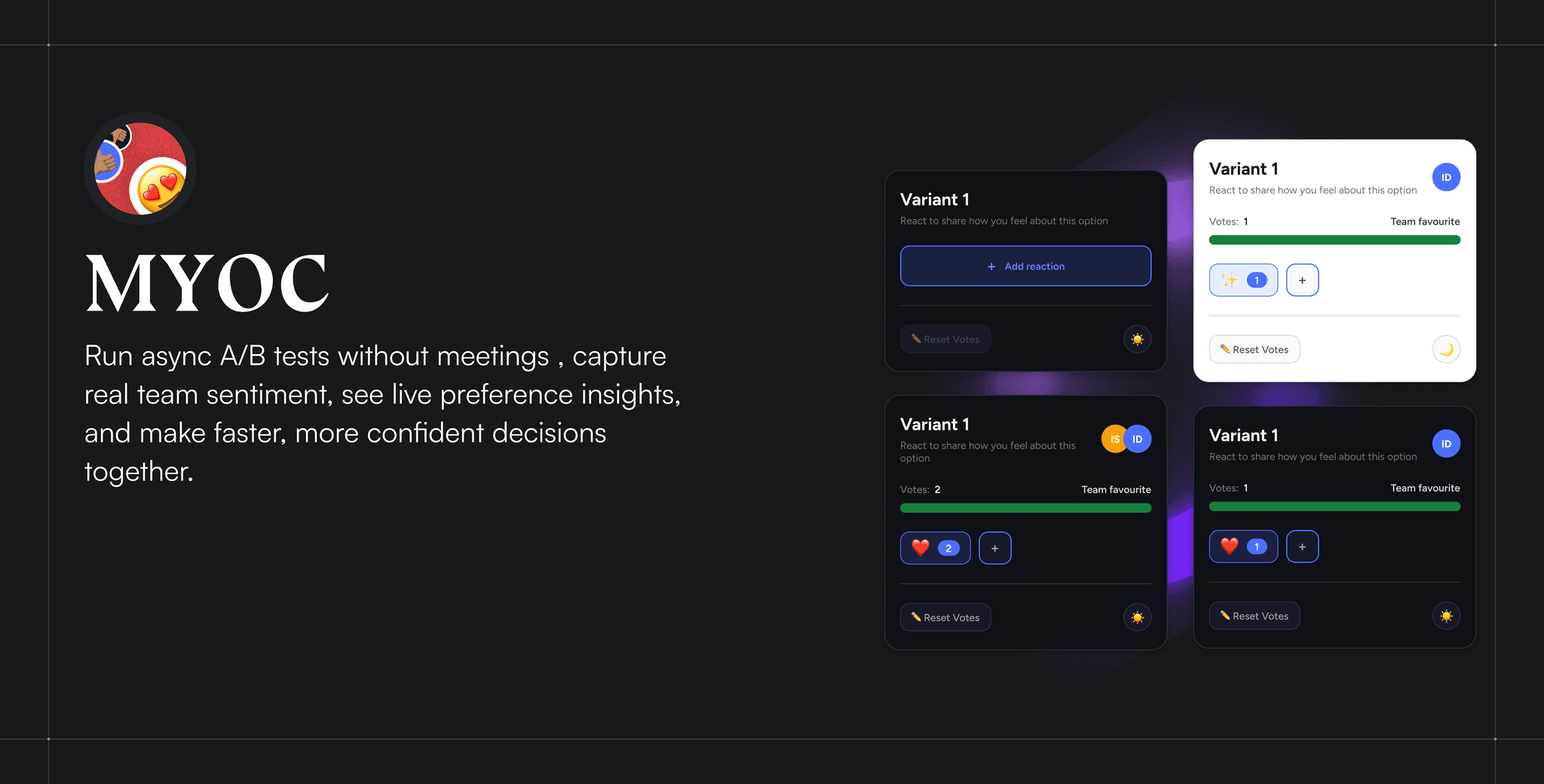
To fix that decision-making bottleneck, I built MYOC. It’s an async A/B testing widget designed to let teams weigh in whenever it actually fits their schedule. Instead of just clicking a button and moving on, MYOC captures the "vibe" behind the choice, using multiple reaction signals to surface live insights. It’s not just about picking a winner; it’s about understanding how the team actually feels. This makes the whole process faster and way more inclusive, giving everyone a voice without needing to hop on another Zoom call.
Ideation & Research
When I started digging into how teams actually make decisions, I spent a lot of time looking at existing feedback tools to see where they were falling short. Most of them were stuck in this world of simple polls and binary "yes or no" voting, which totally kills any sense of nuance. It struck me as odd that none of these tools were using emoji reactions as a core feature, even though most of us already use them every single day to communicate.
That "aha!" moment led me to lean into a familiar interaction model, the kind we use on Slack. I wanted to take that behavior where people pile different emojis onto a single message to express multiple feelings at once and bring it into a structured decision-making tool. Since everyone already speaks "emoji," building the tool around that logic made giving feedback feel intuitive and actually expressive, rather than like a chore.
My design process
A huge part of the process was figuring out how to turn a bunch of random emojis into actual, useful data. I didn't want it to just be a pile of icons; I built a scoring framework that sorted emojis into categories, positive, neutral, and negative, and assigned them weighted values based on their intensity. This meant I could take all that "messy" human expression and turn it into something structured that a team could actually compare and act on.
Since this was a multi-user widget, things got a bit tricky. I spent a lot of time researching how the best collaborative tools handle a bunch of people clicking the same thing at once. I had to solve for things like participant visibility and how to aggregate reactions without the interface becoming a cluttered mess. The goal was to make sure the shared feedback felt clear and intuitive, no matter how many people were weighing in.
I owned the entire product design from start to finish, everything from the initial wireframes and visual direction to the core system decisions. By using Cursor to handle the heavy lifting of the code, I was able to stay in the "Director" seat. I spent my time planning the flows and refining the behavior, iterating on the interface until the widget felt incredibly simple to use, even though there was a lot of complex logic running under the hood.


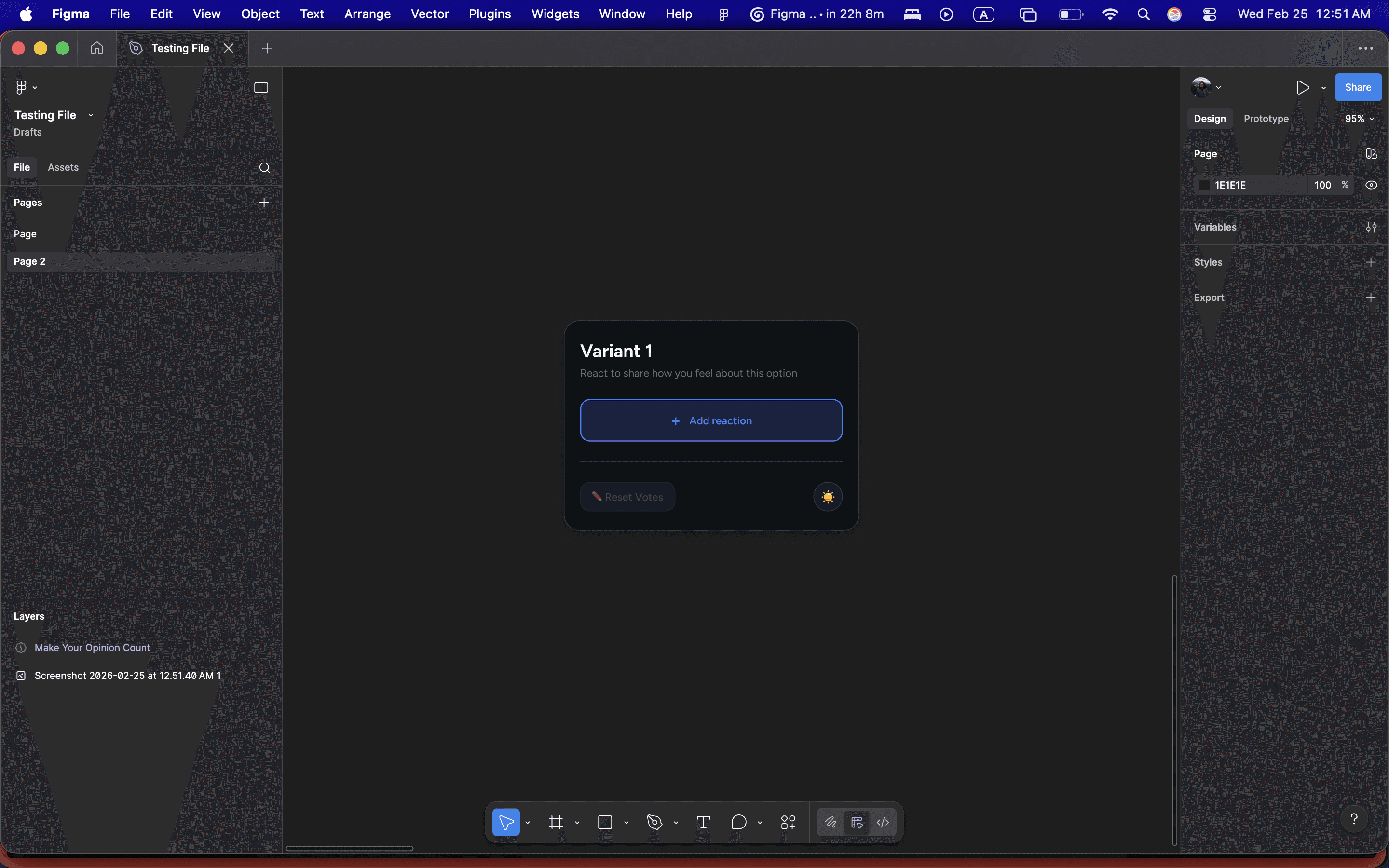


WORKING OF THE PLUGIN
Credits
Closing Thoughts
Ultimately, MYOC is about taking the things we already do, like reacting with an emoji, and turning them into a legit system for making decisions. It’s proof that you don’t need a mountain of extra process or long-winded meetings to get everyone on the same page. By transforming those familiar "gut reactions" into clear, actionable signals, I was able to show how teams can reach a collective understanding faster, without the usual overhead.
WORK INVOLVED
Product Design
Design Systems
Tools
Figma
Cursor
team
Design
Ishika Dixit
Motion
Ishika Dixit
Research
Ishika Dixit
Writing
Ishika Dixit